Why Most BRRR Deals Fail at Refinance (And How to Fix It)
Table of Contents
The BRRR strategy sounds perfect on paper: buy below market value, refurbish to add value, rent the property, then refinance to pull your capital back out. Rinse and repeat. Build a portfolio with the same money recycling through multiple deals. Infinite returns. Compounding wealth.
The reality? Most BRRR deals trap capital rather than recycle it. Investors who master spreadsheet calculations still discover their projected £0 left in the deal becomes £15,000–£30,000 stuck per property. The difference between successful BRRR investors and those who abandon the strategy after two deals comes down to understanding three critical failure points before acquisition, not after completion.
This guide reveals why BRRR deals fail, how professional investors stress-test opportunities, and the exact calculations that separate profitable capital recycling from expensive capital traps.
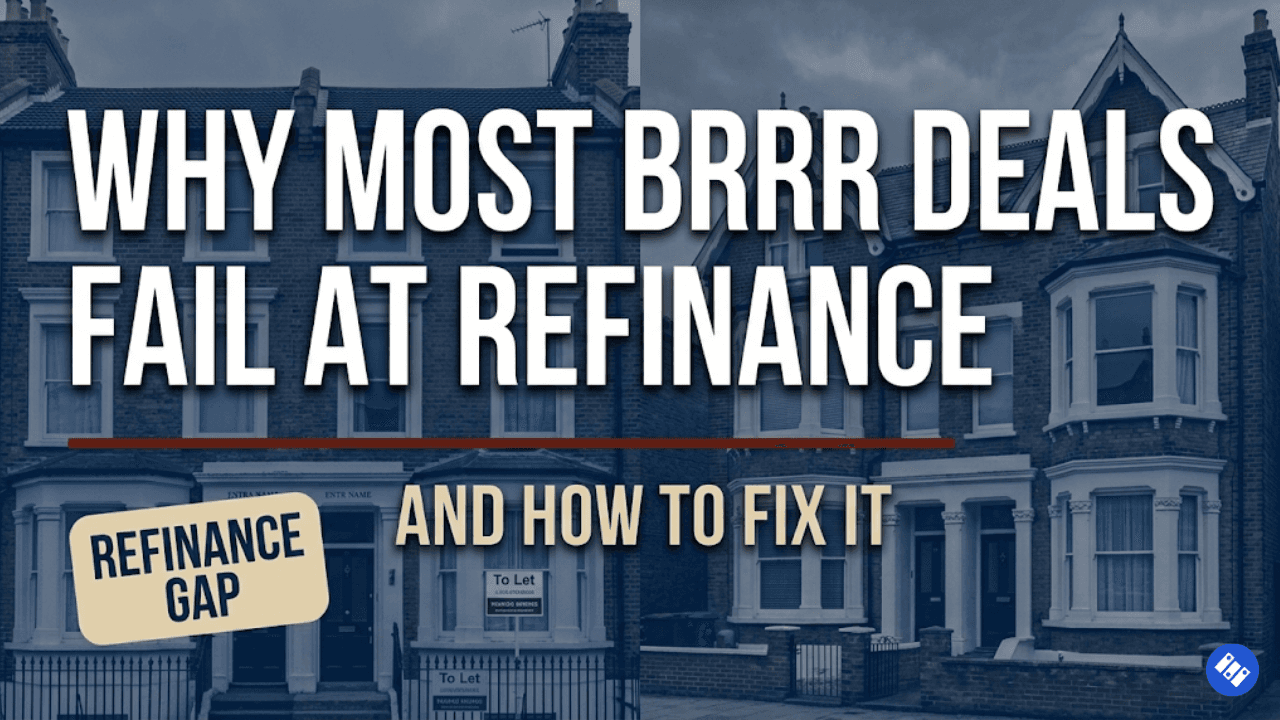
Use the Free BRRR Deal Calculator
Model your complete BRRR strategy before you buy. Calculate cash flow, money left in, ROCE, and stress-test your refinance assumptions with transparent formulas used by professional investors.
The BRRR Promise vs The BRRR Reality
The BRRR strategy appeals to investors because it promises to solve property investment's biggest constraint: limited capital. By recycling the same funds through multiple deals, you can theoretically build a substantial portfolio without requiring hundreds of thousands in liquid capital.
Here's how the BRRR promise typically presents:
You purchase a property for £120,000 that needs £30,000 in refurbishment. Total investment: £150,000 plus acquisition costs (stamp duty, legal fees, surveys) of roughly £8,000. Your all-in cost: £158,000.
After refurbishment, the property's market value increases to £180,000. You refinance at 75% LTV, releasing £135,000. Subtract your refinance fees (£2,000) and you've pulled out £133,000 of your original £158,000 investment. You've left £25,000 in the deal, manageable if the property generates strong cash flow.
Except this scenario assumes everything goes according to plan. In reality, most BRRR deals encounter one or more fatal flaws that trap significantly more capital than projected.
The data reveals the gap: professional BRRR investors typically target leaving £0–£10,000 in deals. Amateur investors frequently leave £20,000–£40,000 per property, destroying the capital recycling thesis entirely.
Why the Refinance Valuation Kills Most Deals
The single biggest BRRR killer isn't finding properties or managing refurbishments, it's the refinance valuation. Investors calculate After Repair Value (ARV) based on open market comparables, then discover mortgage surveyors value properties 5-15% lower using mortgage lending methodology.
The Surveyor's Perspective Isn't Your Perspective
You see three comparable properties on the same street that sold for £185,000. Your refurbished property matches their condition and layout. You confidently estimate your ARV at £180,000 (slightly conservative). You plan your 75% LTV refinance around releasing £135,000.
The mortgage surveyor sees:
Lending risk, not market value. They're valuing for mortgage security, applying downward adjustments for market uncertainty.
Comparable sale timing. Those £185,000 sales occurred 4–6 months ago; current market conditions may differ.
Rental coverage requirements. They stress-test whether rental income covers debt service at assessment rates.
Condition differences. Your "identical" refurbishment may not match the survey standards they consider equivalent.
The surveyor values your property at £165,000. Your 75% LTV drops to £123,750. You've left £36,250 in the deal instead of your projected £25,000. That's £11,250 extra capital trapped, enough to fund another deposit if it had been recycled properly.
The Yield Compression Problem
Some BRRR investors assume higher LTVs (80–85%) will solve the valuation gap. This introduces a different problem: rental coverage ratios.
Most lenders require rental income to cover 125–145% of the mortgage payment at their stress test rate (typically 5.5–7% depending on the lender, versus actual product rates of 4–5%). If your rental income falls below this threshold, lenders either reject the application or reduce the loan amount to meet coverage requirements.
A property generating £850 PCM rental income meets coverage requirements at 75% LTV but fails at 80% LTV because the higher mortgage amount exceeds the rental coverage ratio. The lender approves £120,000 instead of your requested £136,000. More capital stays trapped.
Key takeaway: BRRR success depends on conservative ARV estimates (typically 10–15% below open market comparables) and rental coverage stress-testing before acquisition, not optimistic projections after purchase.
The single biggest BRRR killer isn't finding properties or managing refurbishments, it's the refinance valuation. Investors calculate After Repair Value (ARV) based on open market comparables, then discover mortgage surveyors value properties 5-15% lower using mortgage lending methodology.
The Surveyor's Perspective Isn't Your Perspective
You see three comparable properties on the same street that sold for £185,000. Your refurbished property matches their condition and layout. You confidently estimate your ARV at £180,000 (slightly conservative). You plan your 75% LTV refinance around releasing £135,000.
The mortgage surveyor sees:
Lending risk, not market value. They're valuing for mortgage security, applying downward adjustments for market uncertainty.
Comparable sale timing. Those £185,000 sales occurred 4–6 months ago; current market conditions may differ.
Rental coverage requirements. They stress-test whether rental income covers debt service at assessment rates.
Condition differences. Your "identical" refurbishment may not match the survey standards they consider equivalent.
The surveyor values your property at £165,000. Your 75% LTV drops to £123,750. You've left £36,250 in the deal instead of your projected £25,000. That's £11,250 extra capital trapped, enough to fund another deposit if it had been recycled properly.
The Yield Compression Problem
Some BRRR investors assume higher LTVs (80–85%) will solve the valuation gap. This introduces a different problem: rental coverage ratios.
Most lenders require rental income to cover 125–145% of the mortgage payment at their stress test rate (typically 5.5–7% depending on the lender, versus actual product rates of 4–5%). If your rental income falls below this threshold, lenders either reject the application or reduce the loan amount to meet coverage requirements.
A property generating £850 PCM rental income meets coverage requirements at 75% LTV but fails at 80% LTV because the higher mortgage amount exceeds the rental coverage ratio. The lender approves £120,000 instead of your requested £136,000. More capital stays trapped.
Key takeaway: BRRR success depends on conservative ARV estimates (typically 10–15% below open market comparables) and rental coverage stress-testing before acquisition, not optimistic projections after purchase.
The Hidden Costs That Destroy Cash Flow
Even when refinance valuations hit target, many BRRR properties generate weak or negative cash flow because investors underestimate operating costs and overestimate rental income stability.
The Real Operating Cost Formula
Here's what adequate cost modelling includes:
Mortgage costs. Not the product rate (4–5%), but the stress test rate. Professional investors model at lender assessment rates (typically 5.5–7%) to ensure deals survive interest rate increases.
Management fees. 12–15% of gross rent if using letting agents, or 5–8% if self-managing (to account for your time value).
Maintenance reserve. 10–12% of gross rent annually. Properties need boilers, roofs, and compliance certificates eventually.
Void periods. One month annually minimum (8.33% annual income reduction). Some areas experience higher void rates.
Insurance. Buildings insurance, landlord insurance, sometimes rent guarantee insurance.
Compliance costs. Gas safety certificates (£60–90 annually), EPC renewals (£60–120 every 10 years), electrical safety certificates (£150–250 every 5 years), smoke and CO alarms.
Property licences. HMO licences where required (£500–1,200 initially, renewal every 3–5 years), selective licensing (£500–900).
A property generating £850 PCM gross rent looks profitable with a £580 mortgage payment. Add realistic costs:
Cost | Monthly |
|---|---|
Mortgage | £580 |
Management (12%) | £102 |
Maintenance (10%) | £85 |
Void (8.33%) | £71 |
Insurance | £35 |
Compliance | £25 |
Total monthly cost | £898 |
Actual cash flow | -£48 PCM |
This property loses £576 annually despite appearing profitable without full cost modelling. Over 10 years, that's £5,760 in losses, before any major repairs or unexpected void periods.
Key takeaway: BRRR deals must generate positive cash flow after ALL operating costs, or investors are subsidising properties that trap their capital and cost money to hold.
Even when refinance valuations hit target, many BRRR properties generate weak or negative cash flow because investors underestimate operating costs and overestimate rental income stability.
The Real Operating Cost Formula
Here's what adequate cost modelling includes:
Mortgage costs. Not the product rate (4–5%), but the stress test rate. Professional investors model at lender assessment rates (typically 5.5–7%) to ensure deals survive interest rate increases.
Management fees. 12–15% of gross rent if using letting agents, or 5–8% if self-managing (to account for your time value).
Maintenance reserve. 10–12% of gross rent annually. Properties need boilers, roofs, and compliance certificates eventually.
Void periods. One month annually minimum (8.33% annual income reduction). Some areas experience higher void rates.
Insurance. Buildings insurance, landlord insurance, sometimes rent guarantee insurance.
Compliance costs. Gas safety certificates (£60–90 annually), EPC renewals (£60–120 every 10 years), electrical safety certificates (£150–250 every 5 years), smoke and CO alarms.
Property licences. HMO licences where required (£500–1,200 initially, renewal every 3–5 years), selective licensing (£500–900).
A property generating £850 PCM gross rent looks profitable with a £580 mortgage payment. Add realistic costs:
Cost | Monthly |
|---|---|
Mortgage | £580 |
Management (12%) | £102 |
Maintenance (10%) | £85 |
Void (8.33%) | £71 |
Insurance | £35 |
Compliance | £25 |
Total monthly cost | £898 |
Actual cash flow | -£48 PCM |
This property loses £576 annually despite appearing profitable without full cost modelling. Over 10 years, that's £5,760 in losses, before any major repairs or unexpected void periods.
Key takeaway: BRRR deals must generate positive cash flow after ALL operating costs, or investors are subsidising properties that trap their capital and cost money to hold.
How to Calculate BRRR Deals Like a Professional
Professional BRRR investors use specific metrics to evaluate deals before acquisition. These calculations separate genuine opportunities from capital traps.
Money Left In: The Critical BRRR Metric
Money Left In represents the actual capital remaining in a deal after refinancing.
Formula: Money Left In = Total All-In Cost - New Mortgage Proceeds
Where:
Total All-In Cost = Purchase Price + Stamp Duty + Legal Fees + Survey + Broker Fees + Refurbishment Costs + Refinance Fees
New Mortgage Proceeds = Refinance Valuation x LTV
Target outcome: £0 or negative (you've recycled all your capital and the refinance returns more than you invested)
Acceptable outcome: Under £10,000–£15,000 left in
Warning sign: £20,000 or more (capital trap, not capital recycling)
ROCE: The Performance Measure
Return on Capital Employed shows annual return on capital left in the deal.
Formula: ROCE = (Annual Cash Flow / Money Left In) x 100
If you've successfully recycled all capital (£0 or negative left in), any positive cash flow delivers infinite ROCE. That's the BRRR goal.
If you've left £20,000 in and generate £2,400 annual cash flow, your ROCE is 12%, often worse than simple BTL strategies without the refurbishment risk.
Professional target: Infinite ROCE (£0 left in) or minimum 15%+ if capital remains deployed.
Net Yield With Costs: The Reality Check
Most investors calculate gross yield (rental income / purchase price). This ignores acquisition costs and operating expenses.
Formula: Net Yield With Costs = (Annual Cash Flow After All Costs / Total All-In Cost) x 100
This shows true return on total capital deployed, not just the purchase price.
Professional target: 6%+ net yield with costs (minimum threshold for positive cash flow after realistic operating costs).
Professional BRRR investors use specific metrics to evaluate deals before acquisition. These calculations separate genuine opportunities from capital traps.
Money Left In: The Critical BRRR Metric
Money Left In represents the actual capital remaining in a deal after refinancing.
Formula: Money Left In = Total All-In Cost - New Mortgage Proceeds
Where:
Total All-In Cost = Purchase Price + Stamp Duty + Legal Fees + Survey + Broker Fees + Refurbishment Costs + Refinance Fees
New Mortgage Proceeds = Refinance Valuation x LTV
Target outcome: £0 or negative (you've recycled all your capital and the refinance returns more than you invested)
Acceptable outcome: Under £10,000–£15,000 left in
Warning sign: £20,000 or more (capital trap, not capital recycling)
ROCE: The Performance Measure
Return on Capital Employed shows annual return on capital left in the deal.
Formula: ROCE = (Annual Cash Flow / Money Left In) x 100
If you've successfully recycled all capital (£0 or negative left in), any positive cash flow delivers infinite ROCE. That's the BRRR goal.
If you've left £20,000 in and generate £2,400 annual cash flow, your ROCE is 12%, often worse than simple BTL strategies without the refurbishment risk.
Professional target: Infinite ROCE (£0 left in) or minimum 15%+ if capital remains deployed.
Net Yield With Costs: The Reality Check
Most investors calculate gross yield (rental income / purchase price). This ignores acquisition costs and operating expenses.
Formula: Net Yield With Costs = (Annual Cash Flow After All Costs / Total All-In Cost) x 100
This shows true return on total capital deployed, not just the purchase price.
Professional target: 6%+ net yield with costs (minimum threshold for positive cash flow after realistic operating costs).
Real Example: When the Numbers Don't Add Up
Let's model a BRRR deal with optimistic assumptions, then show what actually happens:
The Optimistic Projection
Item | Amount |
|---|---|
Purchase price | £140,000 |
Stamp duty and fees | £7,000 |
Refurbishment | £25,000 |
Refinance fees | £2,000 |
Total all-in cost | £174,000 |
Post-refurbishment refinance (optimistic assumptions):
Item | Amount |
|---|---|
Projected ARV | £200,000 |
New mortgage (75% LTV) | £150,000 |
Money left in | £24,000 |
Cash flow projection (product rate, underestimated costs):
Cost | Monthly |
|---|---|
Rent | £950 |
Mortgage (I/O at 5%) | £625 |
Other costs (underestimated) | £150 |
Monthly cash flow | £175 |
This looks like a working deal: £24,000 left in and positive cash flow.
The Reality After Execution
Refurbishment overruns by 15%: £28,750 instead of £25,000. Surveyor values at £185,000, not £200,000.
Item | Amount |
|---|---|
Purchase price | £140,000 |
Stamp duty and fees | £7,000 |
Refurbishment (with 15% overrun) | £28,750 |
Refinance fees | £2,000 |
Total all-in cost | £177,750 |
Item | Amount |
|---|---|
Surveyor valuation | £185,000 |
New mortgage (75% LTV) | £138,750 |
Money left in | £39,000 |
That's £15,000 more trapped than the optimistic projection. Capital you were counting on for your next deal.
Now stress-test the cash flow at lender assessment rates:
Cost | Monthly |
|---|---|
Rent | £950 |
Mortgage (I/O at 6%) | £694 |
Management (12%) | £114 |
Maintenance (10%) | £95 |
Void (8.33%) | £79 |
Insurance and compliance | £50 |
Total monthly costs | £1,032 |
Monthly cash flow | -£82 |
Annual cash flow | -£984 |
The Lesson
The BRRR partially worked for capital recycling, but it created a cash-flow liability while leaving £39,000 trapped. This example used conservative assumptions: a 15% refurb overrun and a surveyor's 7.5% downward adjustment. Neither is unusual. Yet together they turned a "working deal" into a loss-making asset that restricts your ability to scale.
Professional investors model worst-case scenarios before acquisition, not best-case projections that assume everything goes to plan.
Let's model a BRRR deal with optimistic assumptions, then show what actually happens:
The Optimistic Projection
Item | Amount |
|---|---|
Purchase price | £140,000 |
Stamp duty and fees | £7,000 |
Refurbishment | £25,000 |
Refinance fees | £2,000 |
Total all-in cost | £174,000 |
Post-refurbishment refinance (optimistic assumptions):
Item | Amount |
|---|---|
Projected ARV | £200,000 |
New mortgage (75% LTV) | £150,000 |
Money left in | £24,000 |
Cash flow projection (product rate, underestimated costs):
Cost | Monthly |
|---|---|
Rent | £950 |
Mortgage (I/O at 5%) | £625 |
Other costs (underestimated) | £150 |
Monthly cash flow | £175 |
This looks like a working deal: £24,000 left in and positive cash flow.
The Reality After Execution
Refurbishment overruns by 15%: £28,750 instead of £25,000. Surveyor values at £185,000, not £200,000.
Item | Amount |
|---|---|
Purchase price | £140,000 |
Stamp duty and fees | £7,000 |
Refurbishment (with 15% overrun) | £28,750 |
Refinance fees | £2,000 |
Total all-in cost | £177,750 |
Item | Amount |
|---|---|
Surveyor valuation | £185,000 |
New mortgage (75% LTV) | £138,750 |
Money left in | £39,000 |
That's £15,000 more trapped than the optimistic projection. Capital you were counting on for your next deal.
Now stress-test the cash flow at lender assessment rates:
Cost | Monthly |
|---|---|
Rent | £950 |
Mortgage (I/O at 6%) | £694 |
Management (12%) | £114 |
Maintenance (10%) | £95 |
Void (8.33%) | £79 |
Insurance and compliance | £50 |
Total monthly costs | £1,032 |
Monthly cash flow | -£82 |
Annual cash flow | -£984 |
The Lesson
The BRRR partially worked for capital recycling, but it created a cash-flow liability while leaving £39,000 trapped. This example used conservative assumptions: a 15% refurb overrun and a surveyor's 7.5% downward adjustment. Neither is unusual. Yet together they turned a "working deal" into a loss-making asset that restricts your ability to scale.
Professional investors model worst-case scenarios before acquisition, not best-case projections that assume everything goes to plan.
The Three Scenarios Every BRRR Investor Must Model
Before making any BRRR offer, run three complete scenarios through your calculations.
Scenario 1: Best Case
Refurbishment on budget
Surveyor values at your conservative ARV estimate
Property lets immediately at target rent
No unexpected costs in year one
Use this to understand maximum potential, but never base acquisition decisions on best case alone.
Scenario 2: Base Case
15% refurbishment contingency included
Surveyor values 5–10% below market comparables
One month void in year one
Mortgage stress-tested at lender's assessment rate (typically 5.5–7%)
Full operating costs included
This is your decision scenario. If base case delivers acceptable ROCE and positive cash flow, the deal likely works.
Scenario 3: Worst Case
25% refurbishment overrun
Surveyor applies maximum conservative valuation (10–15% below comparables)
Two months void in year one
Major repair required (£3,000–£5,000)
Interest rates increase 1%
If worst case is still manageable (even break-even cash flow), you can withstand market uncertainty. If worst case destroys the deal, reconsider acquisition.
Professional investors only proceed when base case works and worst case does not cause insolvency.
Before making any BRRR offer, run three complete scenarios through your calculations.
Scenario 1: Best Case
Refurbishment on budget
Surveyor values at your conservative ARV estimate
Property lets immediately at target rent
No unexpected costs in year one
Use this to understand maximum potential, but never base acquisition decisions on best case alone.
Scenario 2: Base Case
15% refurbishment contingency included
Surveyor values 5–10% below market comparables
One month void in year one
Mortgage stress-tested at lender's assessment rate (typically 5.5–7%)
Full operating costs included
This is your decision scenario. If base case delivers acceptable ROCE and positive cash flow, the deal likely works.
Scenario 3: Worst Case
25% refurbishment overrun
Surveyor applies maximum conservative valuation (10–15% below comparables)
Two months void in year one
Major repair required (£3,000–£5,000)
Interest rates increase 1%
If worst case is still manageable (even break-even cash flow), you can withstand market uncertainty. If worst case destroys the deal, reconsider acquisition.
Professional investors only proceed when base case works and worst case does not cause insolvency.
Your Action Plan: Calculate Before You Commit
BRRR investing works when you model deals with lender-grade assumptions, not homeowner optimism. Here's your step-by-step approach.
Step 1: Gather Accurate Data
Before running calculations, collect:
Completed property comparables from the past 3–6 months (Land Registry or Rightmove sold prices)
Rental comparables with current asking rents (not achieved rents unless verified)
Detailed refurbishment quotes with line-item breakdowns
Current lender criteria for stress test rates and rental coverage ratios
Step 2: Model Your Acquisition
Calculate your total all-in cost:
Purchase price
Stamp duty (use the Property Filter stamp duty calculator for accuracy)
Legal fees (£1,000–£1,500 typical)
Survey costs (£400–£800)
Broker fees if applicable
Refurbishment budget with 15% contingency minimum
Step 3: Calculate a Conservative ARV
Take your comparable sales and reduce by 10% for the surveyor's mortgage lending adjustment. If comparables average £190,000, use £171,000 as your refinance valuation for modelling. Better to be pleasantly surprised than devastated when the surveyor's report arrives.
Step 4: Stress Test Cash Flow
Use lender stress test rates, not product rates, for mortgage calculations. Include all operating costs: management, maintenance reserve, voids, insurance, compliance.
If cash flow turns negative at stress rates, the deal fails. Lenders may not approve refinancing, and you cannot afford to hold the property if rates increase.
Step 5: Calculate Money Left In and ROCE
With conservative refinance valuation and full costs modelled, calculate:
Money Left In = Total All-In Cost - New Mortgage Proceeds
ROCE = (Annual Cash Flow / Money Left In) x 100
If Money Left In exceeds £15,000–£20,000, reconsider the acquisition. The BRRR strategy's core advantage disappears when significant capital remains trapped.
Step 6: Run the Three Scenarios
Model best case, base case, and worst case through complete calculations. Only proceed if base case works and worst case is survivable.
Step 7: Use the BRRR Calculator for Speed
Manual calculations work but take time. Use the Property Filter BRRR Deal Calculator to model all scenarios instantly with transparent formulas showing exactly how each metric is calculated.
The calculator shows:
Money left in with full breakdown
ROCE calculations
Gross and net yields, with and without costs
Monthly and annual cash flow with complete cost modelling
Run multiple properties through the calculator quickly to identify which opportunities genuinely deliver capital recycling rather than capital traps.
BRRR investing works when you model deals with lender-grade assumptions, not homeowner optimism. Here's your step-by-step approach.
Step 1: Gather Accurate Data
Before running calculations, collect:
Completed property comparables from the past 3–6 months (Land Registry or Rightmove sold prices)
Rental comparables with current asking rents (not achieved rents unless verified)
Detailed refurbishment quotes with line-item breakdowns
Current lender criteria for stress test rates and rental coverage ratios
Step 2: Model Your Acquisition
Calculate your total all-in cost:
Purchase price
Stamp duty (use the Property Filter stamp duty calculator for accuracy)
Legal fees (£1,000–£1,500 typical)
Survey costs (£400–£800)
Broker fees if applicable
Refurbishment budget with 15% contingency minimum
Step 3: Calculate a Conservative ARV
Take your comparable sales and reduce by 10% for the surveyor's mortgage lending adjustment. If comparables average £190,000, use £171,000 as your refinance valuation for modelling. Better to be pleasantly surprised than devastated when the surveyor's report arrives.
Step 4: Stress Test Cash Flow
Use lender stress test rates, not product rates, for mortgage calculations. Include all operating costs: management, maintenance reserve, voids, insurance, compliance.
If cash flow turns negative at stress rates, the deal fails. Lenders may not approve refinancing, and you cannot afford to hold the property if rates increase.
Step 5: Calculate Money Left In and ROCE
With conservative refinance valuation and full costs modelled, calculate:
Money Left In = Total All-In Cost - New Mortgage Proceeds
ROCE = (Annual Cash Flow / Money Left In) x 100
If Money Left In exceeds £15,000–£20,000, reconsider the acquisition. The BRRR strategy's core advantage disappears when significant capital remains trapped.
Step 6: Run the Three Scenarios
Model best case, base case, and worst case through complete calculations. Only proceed if base case works and worst case is survivable.
Step 7: Use the BRRR Calculator for Speed
Manual calculations work but take time. Use the Property Filter BRRR Deal Calculator to model all scenarios instantly with transparent formulas showing exactly how each metric is calculated.
The calculator shows:
Money left in with full breakdown
ROCE calculations
Gross and net yields, with and without costs
Monthly and annual cash flow with complete cost modelling
Run multiple properties through the calculator quickly to identify which opportunities genuinely deliver capital recycling rather than capital traps.
The Bottom Line: Calculate or Gamble
BRRR investing works when you model deals with surveyor-grade valuations, stress-test cash flow at lender assessment rates, and factor in realistic operating costs before acquisition. The strategy fails when investors base decisions on optimistic ARV estimates, product-rate mortgage calculations, and incomplete cost modelling.
Every successful BRRR portfolio started with conservative calculations that revealed which opportunities recycle capital versus which trap it. Professional investors don't discover problems after refinancing. They identify and solve them during due diligence.
Calculate your BRRR deals with the same stress-testing rigour lenders apply. Model worst-case scenarios before committing capital. Know your money left in, ROCE, and true cash flow before you make offers.
The difference between BRRR success and BRRR failure isn't luck. It's mathematics applied conservatively.
Want to Analyse Deals Like This?
Join 1,800+ investors who use Property Filter's complete deal-making system to:
Model BRRR, BTL, and HMO strategies with transparent calculators
Track motivated seller pipelines through an integrated CRM
Automate follow-up with proven investor templates
Access twice-weekly Q&As and deal review sessions
Start your free trial or watch the demo to see the complete system in action.
BRRR investing works when you model deals with surveyor-grade valuations, stress-test cash flow at lender assessment rates, and factor in realistic operating costs before acquisition. The strategy fails when investors base decisions on optimistic ARV estimates, product-rate mortgage calculations, and incomplete cost modelling.
Every successful BRRR portfolio started with conservative calculations that revealed which opportunities recycle capital versus which trap it. Professional investors don't discover problems after refinancing. They identify and solve them during due diligence.
Calculate your BRRR deals with the same stress-testing rigour lenders apply. Model worst-case scenarios before committing capital. Know your money left in, ROCE, and true cash flow before you make offers.
The difference between BRRR success and BRRR failure isn't luck. It's mathematics applied conservatively.
Want to Analyse Deals Like This?
Join 1,800+ investors who use Property Filter's complete deal-making system to:
Model BRRR, BTL, and HMO strategies with transparent calculators
Track motivated seller pipelines through an integrated CRM
Automate follow-up with proven investor templates
Access twice-weekly Q&As and deal review sessions
Start your free trial or watch the demo to see the complete system in action.
Related Tools and Resources
BRRR Deal Calculator: Stress-test your refinance before you buy
HMO Valuation Calculator: Model HMO deals using dual valuation methodology
Stamp Duty Calculator: Calculate your full acquisition costs accurately
All Free Calculators: The complete Property Filter calculator suite
Related Tools and Resources
BRRR Deal Calculator: Stress-test your refinance before you buy
HMO Valuation Calculator: Model HMO deals using dual valuation methodology
Stamp Duty Calculator: Calculate your full acquisition costs accurately
All Free Calculators: The complete Property Filter calculator suite

All figures in this article are illustrative examples for educational purposes. Mortgage rates, stress test rates, and lender criteria change regularly. Always verify current rates with a qualified mortgage broker before making investment decisions.

Turn "Someday" Into "Deal Day"

Turn "Someday" Into "Deal Day"

Turn "Someday" Into "Deal Day"

Turn "Someday" Into "Deal Day"
You might also like

HMO Yield UK: What Counts as a Good Return and How to Calculate It Properly
Most investors focus on HMO gross yield and get the numbers wrong. Here is what a good net yield actually looks like, and how to calculate it properly.

The Complete Guide to Rent to SA Profitability: Why Most R2SA Deals Fail (And How to Avoid Becoming One)
Most R2SA deals fail because of one number: occupancy. Learn the three mistakes that destroy R2SA returns and how to stress-test any deal before you sign.

Debunking Serviced Accommodation: How You Can Make it Work in 2025 or be Left Behind with Zac & Eve Ratcliffe
Learn how Zac & Eve Ratcliffe make serviced accommodation work in 2025 with proven strategies for marketing, pricing, security, and guest management.
You might also like

HMO Yield UK: What Counts as a Good Return and How to Calculate It Properly
Most investors focus on HMO gross yield and get the numbers wrong. Here is what a good net yield actually looks like, and how to calculate it properly.

The Complete Guide to Rent to SA Profitability: Why Most R2SA Deals Fail (And How to Avoid Becoming One)
Most R2SA deals fail because of one number: occupancy. Learn the three mistakes that destroy R2SA returns and how to stress-test any deal before you sign.

Debunking Serviced Accommodation: How You Can Make it Work in 2025 or be Left Behind with Zac & Eve Ratcliffe
Learn how Zac & Eve Ratcliffe make serviced accommodation work in 2025 with proven strategies for marketing, pricing, security, and guest management.
You might also like

HMO Yield UK: What Counts as a Good Return and How to Calculate It Properly
Most investors focus on HMO gross yield and get the numbers wrong. Here is what a good net yield actually looks like, and how to calculate it properly.

The Complete Guide to Rent to SA Profitability: Why Most R2SA Deals Fail (And How to Avoid Becoming One)
Most R2SA deals fail because of one number: occupancy. Learn the three mistakes that destroy R2SA returns and how to stress-test any deal before you sign.