Free HMO Valuation Calculator
See your deal through a surveyor's eyes. Enter your gross rent, operating costs, and local yield to calculate the commercial valuation lenders will use, before you commit capital.
What You'll Calculate
Four numbers that tell you
if your HMO deal adds up.
Commercial Valuation
The income-based value surveyors and lenders apply to larger HMOs. This is the figure that determines your maximum refinance loan.
Net Operating Income
Gross rent minus surveyor-standard operating costs. This is the figure surveyors capitalise, not your actual net profit.
Investment Yield Applied
The capitalisation rate for your area. Lower yield means higher value. Geography determines this, not your operational performance.
Value Uplift
The difference between your commercial valuation and the bricks and mortar purchase price. The proof point for BRRR HMO investing.
What's Included
What This Calculator Covers
Commercial valuation using the RICS investment method: Net Operating Income divided by market yield, the same formula RICS surveyors use for larger HMOs, typically six beds and above.
Surveyor-standard operating cost deductions: Default 23% for self-managed HMOs. Adjust to 35–45% if bills are included or professionally managed. This deduction applies regardless of your actual costs.
Regional yield context: Investment yields vary from 6.5% in prime London to 12%+ in the North East. The calculator shows how location directly determines capital value from the same income.
How It WorkS
How to Use the HMO Valuation Calculator
Enter your gross annual rent
Total room income before any deductions. Multiply your weekly room rents by 52, then add them together. Use market rent, not your optimistic top-end figure.
Set your operating costs
Use 23% as a starting point for self-managed with bills excluded. Increase to 35–45% if bills are included or a management company is involved. Surveyors apply their own deductions regardless, so build in realism here.
Enter the investment yield for your area
8–12% covers most UK markets in 2026. London prime sits at 6.5–9%. North West typically 8–13%. North East 11–15%. Use local comparable HMO sales as your guide, not national averages
Read your commercial valuation and Value Uplift
The calculator shows your estimated commercial valuation, NOI, and the Value Uplift over bricks and mortar purchase price. If the uplift is positive and large enough to cover your refurbishment costs, the HMO BRRR works.
Why Your HMO Might Be Worth More Than You Think
(and Why Surveyors Might Still Disagree)
Two Valuations. One Property. Completely Different Numbers.
When a mortgage surveyor values your HMO, the method they choose determines whether your BRRR works.
The default is bricks and mortar. The surveyor finds comparable sold prices nearby and values your property the same way they would a family home. It does not matter that you have six letting rooms generating £40,000 a year. If the three-bed semi next door sold for £200,000, you get £200,000.
The alternative is a commercial investment valuation. The surveyor ignores comparable sales and focuses entirely on the income the property generates. Gross rent minus operating costs, divided by a market yield. This is how businesses are valued, and it is the method that rewards strong operational performance.
Commercial valuations typically apply to HMOs with six beds or more, Sui Generis HMOs (seven or more occupants), properties in Article 4 areas where new HMOs are restricted, and layouts that are genuinely difficult to revert to family use. Below that threshold, most lenders default to bricks and mortar.
The deal that fails at bricks and mortar valuation can succeed at commercial valuation, if the income supports it. Knowing which method your lender will instruct before you buy is the difference between a BRRR that works and capital trapped in bricks.
Even if you self-manage your HMO for nothing, a surveyor will not use your actual management costs. They apply a standardised deduction to account for what would happen if a professional management company took over.
That deduction is typically 20–25% for self-managed, bills-excluded HMOs. For bills-included or professionally managed properties, it rises to 35–45%.
This deduction is applied to gross rent before any valuation calculation begins. On a £40,000 gross rent at 23%: the surveyor starts with £30,800, not £40,000.
The yield the surveyor applies determines capital value more than any other variable. It is set by market evidence: comparable HMO investment sales in your area. Not your operational performance, and not your asking price.
A £30,800 NOI at a 7% yield (London) produces a commercial valuation of approximately £440,000. The same NOI at a 12% yield (North East) produces approximately £257,000. Identical property. Identical income. A £183,000 difference driven entirely by location.
That is why running this calculator with the right local yield (not a national average) produces a meaningful estimate.
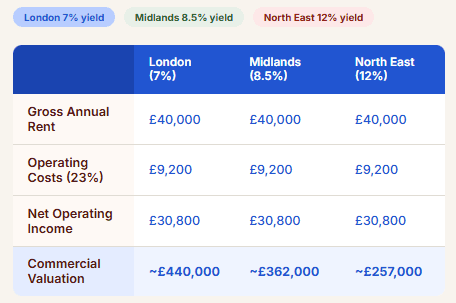
Same property, same income, three completely different valuations. Geography determines capital value.
Gross Annual Rent
Total room income before any deductions. This is your starting figure, the surveyor applies their own cost deductions from here.
Net Operating Income (NOI)
Gross rent minus operating costs. The figure surveyors capitalise to arrive at commercial value. Not the same as your actual net profit.
Investment Yield
The capitalisation rate derived from comparable HMO investment sales in your area. Lower yield means higher value. The surveyor sets this. You cannot choose it.
Value Uplift
Commercial valuation minus bricks and mortar purchase price. Positive uplift means the HMO strategy adds capital value. Negative means it does not.
⚠️ Disclaimer: This HMO valuation calculator provides estimates based on RICS surveyor methodologies. Actual valuations may vary depending on property condition, location, and market factors. This tool is for informational purposes only and does not constitute financial or investment advice. Always consult with qualified professionals before making property investment decisions.
Common Questions
Frequently Asked Questions
What is an HMO commercial valuation and when does it apply?
What operating costs do surveyors deduct when valuing an HMO?
What investment yield will a surveyor apply to my HMO?
How is a commercial valuation different from a bricks and mortar valuation?
Can I use this calculator before making an offer?
What is Value Uplift and why does it matter for BRRR investors?
More Free Tools
More Free Property Calculators
Every calculator your deals need. Free, no signup required.
Free HMO Hotspot Guides
You know what the HMO is worth. These are the areas worth buying it in.
Standard HMO Hotspots Guide
40 locations across major UK cities, with postcodes, average room rents by type and Article 4 status. For letting to working tenants.
Student HMO Hotspots Guide
50 university locations with postcodes, rents by room type and Article 4 guidance, plus why high demand and high profit are not the same thing.
Premium HMO Hotspots Guide
Where the higher end of the HMO market pays, and what makes a premium room let at a premium rent.
Ready to Go Further?
Stop Guessing. Start Knowing.
Over 1,800 investors use Property Filter to run numbers, find deals, and recycle capital. The software, the data, and the community to do more deals, not chase the wrong ones.