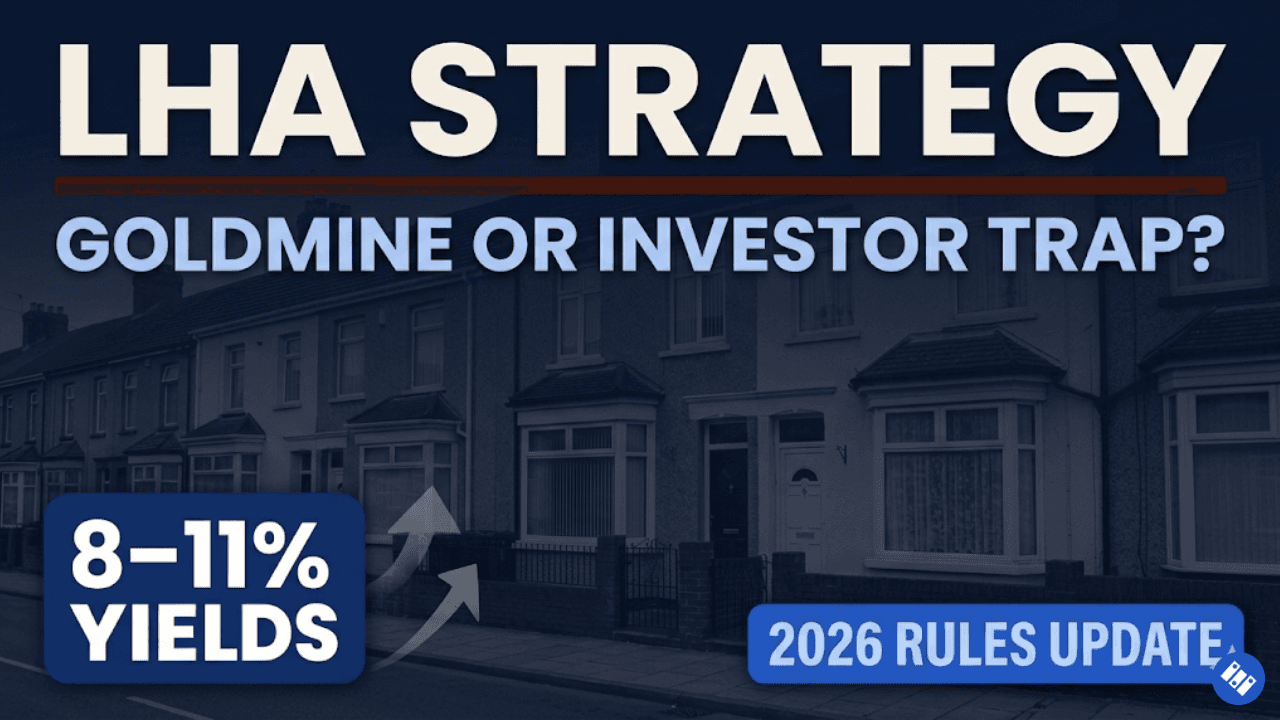
The LHA Strategy: Hidden Goldmine or Investor Trap?
Let's be honest. When most property investors hear "Local Housing Allowance," "Universal Credit," or "DSS," they run for the hills. They picture rent arrears, mountains of paperwork, and endless headaches.
But while the amateurs are scared off by the stigma, sophisticated investors are quietly building portfolios with gross yields of 8% to 11%. Returns that are almost impossible to find in the standard buy-to-let market right now.
The LHA strategy is not a charity. It is not passive. It is a specific asset class with its own rules, risks, and rewards. Treat it like a business and it can be the most robust cash-flow engine in your portfolio.
Here is the no-nonsense guide to making it work in 2026.
The core concept: the government is your customer
At its simplest, the LHA strategy involves letting your property to tenants who receive housing support from the state.
Unlike the open market, where rent depends on what a tenant feels they can afford, LHA revenue is determined by a formula managed by the Valuation Office Agency (VOA). Rates are set at the 30th percentile of local market rents, meaning the government explicitly targets the cheaper end of each area's market.
The opportunity: If you buy a high-spec property, you lose. But if you buy a clean, safe, standard property in a lower-value area, the LHA rate often acts as a floor, delivering a high yield relative to a cheap purchase price.
That predictability is the whole point. In a volatile market, a government-backed revenue floor is a powerful thing to have.
The 2026 landscape: two rules every investor must know
Two major changes have reshaped the LHA market since 2024. Both matter.
Blanket "No DSS" bans are now illegal
The Renters' Rights Act received Royal Assent in October 2025. Landlords can no longer refuse a tenant solely because they receive housing benefit or Universal Credit. You must assess every applicant on affordability. If the LHA rate covers the rent, the tenant is affordable, and you have no legal basis to decline them on that ground alone.
You can still require a guarantor where there is a shortfall. What you cannot do is close the door before looking.
LHA rates are frozen through at least 2026
Rates were increased in April 2024 to bring them back in line with market rents. A welcome reset. Then, in April 2025, they were frozen again.
What this means for investors: Market rents are rising. Your LHA income is not. The shortfall gap (the difference between the LHA rate and current market rent) is widening. In some areas, it already exceeds £100 per month. Screen for tenant affordability carefully and always require a guarantor where a gap exists.
Where the yields are: a North vs. South play
The data on this is clear: LHA investing is a geography game.
In London and the South East, high capital values crush yields to near zero even with full LHA coverage. The Benefit Cap (a separate ceiling on total household benefits) compounds the problem in expensive London boroughs, reducing actual payments below the standard LHA rate.
The sweet spot is in the North and Wales, where purchase prices are low and LHA rates remain robust relative to the mortgage cost.
Sunderland and Teesside: 2-bed terraces under £70,000 delivering 8-11% gross yields
Wales: Some of the strongest yield growth in the UK through 2025 and into 2026
The "Goldilocks" asset: A 2-bed terraced house. Attracts small families who stay longer than single tenants, and liquid enough to sell when needed.
Before you commit to a postcode, check the exact LHA rate for that Broad Rental Market Area. The Property Filter LHA Rates Map shows every BRMA across England, Wales, and Scotland, by bedroom size, region, and property type, so you can verify the numbers before making an offer.
Looking for an LHA Rates Map?
Find the exact housing benefit rate for any UK postcode in seconds. Our free interactive map covers all bedroom categories from shared accommodation to 4-bed family homes, updated April 2025.
The three bear traps: and how to step around them
The LHA sector has specific pitfalls that do not exist in the professional let market. Know these before you buy.
Trap 1: The Under-35 Rule
A single tenant under 35 is generally only entitled to the Shared Accommodation Rate (SAR), even if they rent a self-contained flat.
Example: You rent a 1-bed flat for £550/month. Your tenant is 25. The SAR in that area is £350. You are immediately facing a £200/month shortfall the tenant almost certainly cannot cover.
Solution: Always check the tenant's age and bedroom entitlement before agreeing a rent. The LHA Rates Map shows the SAR alongside all other bedroom rates for every BRMA.
Trap 2: Universal Credit cash flow
Under Universal Credit, housing payments go to the tenant, not to you. For vulnerable tenants, receiving a large lump sum can lead to rent being spent before it reaches you.
Solution: Apply for an Alternative Payment Arrangement (APA) early. If your tenant has a history of debt, addiction, or mental health vulnerability, the DWP can route the housing element directly to you from day one. Do not wait for arrears to build before applying.
Trap 3: The spare room penalty
If a family renting your 3-bed house has only one child, the government may consider them to be under-occupying. Their benefit can be cut by 14-25%.
Solution: Rigorous referencing. Match household size to property size according to VOA rules before signing a tenancy. A mismatch here creates guaranteed arrears.
Your LHA investment checklist
Before you make an offer on any LHA property:
Verify the exact LHA rate for your target BRMA and bedroom count using the LHA Rates Map
Calculate gross yield at multiple purchase prices, not just the asking price
Identify the shortfall gap between LHA rate and your target rent
Require a guarantor for any shortfall. Do not rely on the tenant to top up
Check tenant age. Under-35s on their own only qualify for the Shared Accommodation Rate
Match household size to property. Mismatches trigger the spare room penalty
Source specialist insurance. Standard landlord policies often exclude benefit tenants (expect 15-20% higher premiums)
Stress test cash flow at 7-8% interest rates with frozen LHA income through 2026
The bottom line
LHA property investment is not passive. It requires hands-on management and a real understanding of the welfare system. But in a market where predictable cash flow is increasingly rare, a government-backed revenue floor, properly managed, is a serious asset.
The investors who do well here:
Buy in high-yield Northern and Welsh areas where purchase prices are low relative to LHA rates
Screen tenants rigorously for affordability, not simply for benefit status
Apply for APAs early and require guarantors where any shortfall exists
Stress test every deal at 7-8% interest rates before committing
Know your numbers before you buy.
Looking for an LHA Rates Map?
Check the exact LHA rate for your target area before making an offer. Our free interactive map covers every BRMA across England, Wales, and Scotland. Updated April 2025, no signup needed.