Is Your HMO Undervalued? The Formula Surveyors Use to Down-Value Your Deal
You have done the hard work. Found a tired property, managed the refurbishment, filled it with tenants. The cash flow is strong.
Then comes the refinance valuation.
You are expecting a figure based on the income your asset generates. Instead, the surveyor returns with a bricks and mortar number that barely covers your refurbishment costs.
It is frustrating. But valuations are not random. They follow a formula. Understand the formula, and you can predict the outcome before you commit capital, and structure deals that pass.
The Tale of Two Valuations
Surveyors use two completely different methods to value HMOs, and the method they choose determines whether your deal works.
Bricks and mortar (the default)
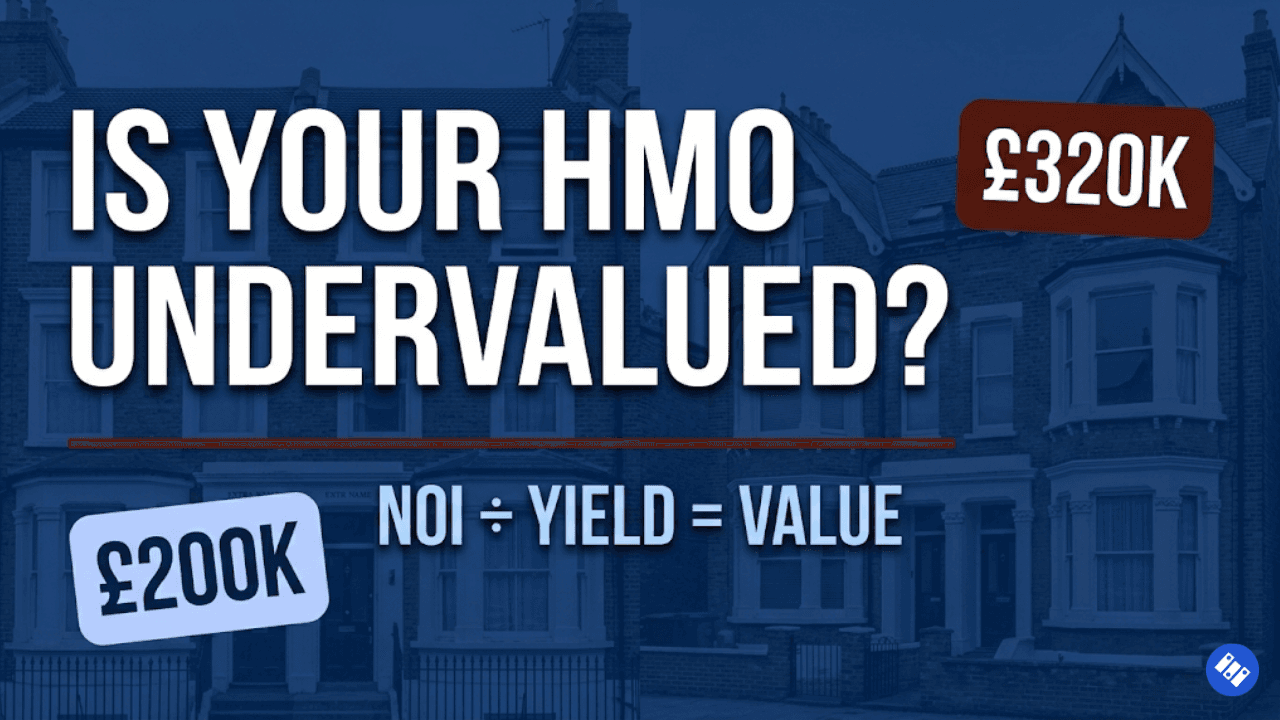
This is how most residential homes are valued. The surveyor finds comparable sold prices nearby and values your property in the same way they would a family home. It does not matter that you have six letting rooms generating £40,000 a year. If the three-bed semi next door sold for £200,000, you get £200,000.
En-suites, fire doors, and strong rental history are invisible in this method. Operational performance counts for nothing.
Commercial investment value (the income method)
This is where profitability gets recognised. A commercial valuation treats your property as a business. Comparable sales are ignored. The valuation is derived entirely from the income the property generates, divided by a market yield.
Commercial valuations typically apply to:
Sui Generis HMOs (seven or more occupants in most local authorities)
HMOs in Article 4 areas where new conversions are restricted
Properties with six or more beds that are difficult to revert to single-family use
Any HMO where the income generates a materially higher value than comparable residential sales
Below that threshold, most lenders default to bricks and mortar regardless of how strong the income is.
The Surveyor Formula Explained
When a surveyor conducts a commercial valuation, the calculation is straightforward:
Valuation = Net Operating Income (NOI) divided by Market Yield
The complexity is in the inputs.
Step 1: Calculate NOI
Net Operating Income is not your actual profit. It is gross annual rent minus a standardised set of operating costs the surveyor applies whether or not you actually incur them.
On a £40,000 gross rent with a 23% cost deduction: NOI = £30,800.
Step 2: Apply the market yield
The yield is set by the surveyor based on comparable HMO investment sales in your area. You cannot choose it. A lower yield produces a higher valuation. A higher yield reduces it.
At 8% yield: £30,800 divided by 0.08 = £385,000 commercial valuation
At 12% yield: £30,800 divided by 0.12 = £257,000 commercial valuation
Same property. Same income. A £128,000 difference driven entirely by location.
Breaking Down the Operating Cost Deduction
The operating cost deduction is where most investors underestimate what surveyors will do to their gross rent. Even if you self-manage your HMO for free, the surveyor applies professional management costs because they must assume a management company could take over at any point.
Typical deductions applied by surveyors:
Cost Item | Typical Range |
|---|---|
Management fees (professional rate) | 10-15% of gross rent |
Void period allowance | 5-8% of gross rent |
Maintenance and repairs sinking fund3-5% of gross rent | 3-5% of gross rent |
Insurance | 1-2% of gross rent |
Licensing and compliance costs | 1-2% of gross rent |
For a self-managed HMO with bills excluded, total deductions typically run at 20-25% of gross rent.
For a bills-included or professionally managed HMO, add utility costs and the deduction rises to 35-45%. A six-bed HMO where the landlord pays all bills could see the surveyor deduct 40% from gross rent before any yield calculation begins.
The practical impact: On a £45,000 gross rent HMO:
At 23% deduction: NOI = £34,650
At 40% deduction: NOI = £27,000
At 8.5% yield, that is a valuation difference of approximately £88,800
Knowing which deduction rate your lender's surveyor is likely to apply before you structure the deal matters.
Regional Yields: What Surveyors Apply Across the UK in 2026
The investment yield a surveyor applies is not a national average. It reflects local comparable HMO sales, investor demand, and the risk profile of the specific market. These are the typical ranges by UK region in 2026:
Region | Typical HMO Yield Range | Notes |
|---|---|---|
Greater London | 6.5-9% | Compressed yields in prime postcodes; highest capital values |
South East | 7-9.5% | High purchase prices limit returns despite strong demand |
South West | 7-9% | Bristol is a notable HMO market with solid professional demand |
East of England | 7-11% | Higher purchase prices compress yields |
West Midlands | 7.5-10% | Birmingham averaging around 7.6-8.5% for professional HMOs |
East Midlands | 8-10% | Nottingham student HMOs often sit at 6.5-7.5% |
Yorkshire and Humber | 8-11% | Leeds can achieve 8-15% depending on property and tenant type |
North West | 8-13% | Manchester and Salford are the UK's largest HMO market by volume |
North East | 11-15% | Highest yields nationally; lowest capital values for the same income |
Scotland | 7-9% | Edinburgh growing strongly; limited Article 4 complications in most areas |
Wales | 8-10% | Limited Article 4 restrictions in most areas |
What this means for investors: A six-bed HMO generating £40,000 gross rent with a 23% cost deduction has an NOI of £30,800. At a London yield of 7.5%, the commercial valuation is approximately £411,000. At a North East yield of 13%, the same property is valued at approximately £237,000. Your strategy and target region should be chosen with this difference in mind, not discovered at refinance.
The Value Uplift: Where BRRR Proof Lives
Value Uplift is the difference between the commercial valuation your HMO achieves and the bricks and mortar price you paid for it. It is the proof point for HMO BRRR investing.
A worked example:
You buy a five-bed property for £190,000 and spend £45,000 converting it to a compliant, licensed six-bed HMO. Total capital in: £235,000.
The property generates £38,400 gross annual rent. Surveyors apply 23% operating costs, giving an NOI of £29,568. At an 8.5% yield, the commercial valuation is approximately £347,860.
Value Uplift: £347,860 minus £235,000 = £112,860
At 75% LTV you can refinance to approximately £260,895. You pull back £235,000 of your capital (and more). The deal works.
Now run the same deal at a 12% yield. Commercial valuation: approximately £246,400. At 75% LTV: £184,800. Your £235,000 is trapped. You cannot recycle capital. The deal does not work.
The yield applied by the surveyor is the variable that determines the outcome. Running this calculation before you make an offer is not optional for BRRR investors.
Run Your Own Numbers
Stop guessing what surveyors will say. Use Property Filter's free HMO Valuation Calculator to see your deal through their eyes before you commit capital.
The tool calculates:
Commercial valuation using the RICS investment method
Net Operating Income after surveyor-standard deductions
Value Uplift over your bricks and mortar purchase price
How regional yield changes affect your valuation
Common Questions About HMO Valuations
What is the formula surveyors use to value larger HMOs?
Surveyors use the RICS investment method: Net Operating Income (gross annual rent minus operating costs) divided by a market investment yield. The yield is derived from comparable HMO sales in the area and cannot be chosen by the investor or lender.
What counts as a larger HMO for commercial valuation purposes?
Most lenders apply commercial valuation methodology to HMOs with six or more beds. Some apply it from five beds. Sui Generis HMOs (seven or more occupants) are almost always commercially valued. Below these thresholds, surveyors often revert to comparable residential sales, regardless of rental income.
Can I influence the commercial valuation my surveyor arrives at?
You cannot choose the yield, but you can improve the valuation by maximising gross rent (through room quality and specification), minimising the operating cost percentage the surveyor applies (by excluding bills and demonstrating strong management), and purchasing in a location where comparable HMO investment sales support a lower yield.
What is the difference between gross yield and investment yield in HMO valuations?
Gross yield is gross rent divided by property value. Investment yield (also called capitalisation rate or cap rate) is Net Operating Income divided by property value. The investment yield is the figure surveyors use in commercial HMO valuations because it reflects the income that would remain after a professional management company took over.
How do Article 4 areas affect HMO valuations?
Article 4 directions restrict new HMO conversions in designated areas, creating scarcity value for existing licensed HMOs. This scarcity is reflected in lower investment yields by surveyors, which produces higher commercial valuations for the same income. An HMO in an Article 4 area will often achieve a higher commercial valuation than an identical property outside the restriction zone.
Should I use the HMO valuation calculator before or after making an offer?
Before. The purpose of the calculator is to determine whether the deal works at refinance before you commit capital. If the commercial valuation at your local yield does not comfortably exceed your total costs (purchase price plus refurbishment), the BRRR strategy does not stack up on that property. Run the numbers before you view, not after you are committed.
The Bottom Line
HMO valuations are formulaic, not judgmental. Surveyors apply a standardised method and the output is determined by two variables: the operating cost deduction and the local investment yield. Both are knowable before you buy.
Key points:
Commercial valuations apply NOI divided by market yield, not comparable sales
Operating cost deductions run at 20-25% for self-managed HMOs and 35-45% for bills-included properties
Investment yields in 2026 range from 6.5% in prime London to 15% in the North East
Value Uplift is the proof point: commercial valuation minus total capital invested
Running the numbers before you make an offer separates investors who recycle capital from those who trap it
Looking for the HMO Valuation Calculator?
Use Property Filter's free tool to calculate your commercial valuation, NOI, and Value Uplift using the same formula RICS surveyors apply. No signup needed.