MEMBER's SUCCESS STORY
How Nisha and Jas Jassal Used Property Filter to Scale Their HMO Portfolio from One Deal Every 18 Months to Seven at Once

Medway, Kent. 12 to 15 deals accepted in two years. A 3-bed to 7-bed HMO secured at £250,000 - £100,000 below asking. 75% of research time saved.
Nisha and Jas Jassal · Castlewood Homes · Medway, Kent · HMO and Buy-to-Let Investors · Interviewed Mar 2026
AT A GLANCE
Member
Nisha and Jas Jassal
Company
Castlewood Homes
Location
Medway, Kent (North Kent - remote investing)
Strategy
HMOs and buy-to-lets; 15 years investing; team of 12-15
PF Feature Used
Pipeline; comparables; price history graph; letter campaigns; follow-up system; comments box
Result
12-15 deals accepted in 2 years; scaled from 1 deal every 18 months to 7 at once; 3-bed HMO secured at £250,000 against £350,000 asking price
Results like these are happening every week. See how Property Filter works.

Nisha and Jas Jassal had been investing in property for 15 years when they first started using Property Filter. They were not beginners. Castlewood Homes was already operating in Medway, Kent with a team of 12 to 15 staff, a growing HMO and buy-to-let portfolio, and years of experience behind them. The problem was not knowledge - it was system. They were both checking Rightmove and Zoopla independently, reviewing the same properties without realising it, and getting into arguments about deals because there was no shared record of what they had already looked at. One deal every 18 months was the result. Within two years of using Property Filter, they had 12 to 15 deals accepted and were managing 5, 6, and 7 properties at the same time.
Nisha and Jas's challenge before Property Filter
Nisha and Jas Jassal are experienced investors. They had been buying property for 15 years before they found Property Filter, and by the time they joined they had already built a team of 12 to 15 virtual and on-the-ground staff to support Castlewood Homes. But experience and infrastructure could not solve the problem they had created for themselves with their search process. Both of them were checking Rightmove and Zoopla. Both of them were signing up for alerts. Both of them were receiving the same emails each day and scrolling through the same properties. They just were not doing it at the same time.
The result was duplicated effort and a complete absence of shared records. When they sat down to discuss deals, one of them would mention a property only to be told the other had already looked at it and rejected it. Or worse, both of them had looked at it, come to different conclusions, and neither had written anything down. "A lot of unnecessary arguments over which property worked and what didn't," Nisha says. Spreadsheets did not solve it - "endless columns, endless lists of things that don't really make sense." Folders did not solve it. There was no version of a manual system that could replicate what they actually needed, which was a shared pipeline both partners could access, update, and trust.
The other problem was scale. At one deal every 18 months, their search process was not going to build the portfolio they wanted. They had tried to systemise manually, but without a purpose-built tool, their process kept reverting to the same chaos. Nisha and Jas were not looking for more data. They were looking for a system. That is what brought them to Property Filter, and it worked from the first day they used it.
"There was a lot of energy wasted - and a lot of unnecessary arguments over which property worked and what didn't, and had we seen it or had we not."
How Nisha and Jas use Property Filter to run their HMO and buy-to-let pipeline in Medway
Nisha and Jas now use Property Filter two to three times a week. Before, they were checking Rightmove and Zoopla every day and still feeling like they were missing things. The difference is structure. Property Filter's pipeline gave them a defined process - and it gave each of them a clearly defined role within it. Either partner can do the initial trawl, filtering down properties by their deal criteria and hiding anything that clearly does not work. Jas then picks up the analysis: comparables, price per square foot, EPC, last sold price. Nisha does the viewing. "It's almost like passing the baton back and forth," she says. Nothing is reviewed twice. Nothing falls through the cracks.
The shared pipeline also solved the argument problem. When a property is in the system and has comments attached to it - notes from agent calls, offer history, follow-up dates - neither of them needs to remember what happened. The pipeline holds the context. They can each go on at separate times, pick up exactly where the other left off, and move the deal forward without a conversation. The property sourcing software effectively became their shared operating system for deal flow.
Their follow-up process is one of the most significant changes. They used to rely on memory and ad hoc reminders. Now every rejected offer goes straight into the follow-up queue in the pipeline. Jas describes it as the pipeline forming "almost like a little business" in itself: always prompting the next action, always making it clear which deals need attention. Two to three sessions per week is enough to keep 12 to 15 active deals moving simultaneously - something that would have been unmanageable with the Rightmove-and-spreadsheet approach they used before.
"We're not redoing the work that the other one's done. It's almost like passing the baton back and forth, depending on our expertise."
Nisha and Jas's challenge before Property Filter
Nisha and Jas Jassal are experienced investors. They had been buying property for 15 years before they found Property Filter, and by the time they joined they had already built a team of 12 to 15 virtual and on-the-ground staff to support Castlewood Homes. But experience and infrastructure could not solve the problem they had created for themselves with their search process. Both of them were checking Rightmove and Zoopla. Both of them were signing up for alerts. Both of them were receiving the same emails each day and scrolling through the same properties. They just were not doing it at the same time.
The result was duplicated effort and a complete absence of shared records. When they sat down to discuss deals, one of them would mention a property only to be told the other had already looked at it and rejected it. Or worse, both of them had looked at it, come to different conclusions, and neither had written anything down. "A lot of unnecessary arguments over which property worked and what didn't," Nisha says. Spreadsheets did not solve it - "endless columns, endless lists of things that don't really make sense." Folders did not solve it. There was no version of a manual system that could replicate what they actually needed, which was a shared pipeline both partners could access, update, and trust.
The other problem was scale. At one deal every 18 months, their search process was not going to build the portfolio they wanted. They had tried to systemise manually, but without a purpose-built tool, their process kept reverting to the same chaos. Nisha and Jas were not looking for more data. They were looking for a system. That is what brought them to Property Filter, and it worked from the first day they used it.
"There was a lot of energy wasted - and a lot of unnecessary arguments over which property worked and what didn't, and had we seen it or had we not."
How Nisha and Jas use Property Filter to run their HMO and buy-to-let pipeline in Medway
Nisha and Jas now use Property Filter two to three times a week. Before, they were checking Rightmove and Zoopla every day and still feeling like they were missing things. The difference is structure. Property Filter's pipeline gave them a defined process - and it gave each of them a clearly defined role within it. Either partner can do the initial trawl, filtering down properties by their deal criteria and hiding anything that clearly does not work. Jas then picks up the analysis: comparables, price per square foot, EPC, last sold price. Nisha does the viewing. "It's almost like passing the baton back and forth," she says. Nothing is reviewed twice. Nothing falls through the cracks.
The shared pipeline also solved the argument problem. When a property is in the system and has comments attached to it - notes from agent calls, offer history, follow-up dates - neither of them needs to remember what happened. The pipeline holds the context. They can each go on at separate times, pick up exactly where the other left off, and move the deal forward without a conversation. The property sourcing software effectively became their shared operating system for deal flow.
Their follow-up process is one of the most significant changes. They used to rely on memory and ad hoc reminders. Now every rejected offer goes straight into the follow-up queue in the pipeline. Jas describes it as the pipeline forming "almost like a little business" in itself: always prompting the next action, always making it clear which deals need attention. Two to three sessions per week is enough to keep 12 to 15 active deals moving simultaneously - something that would have been unmanageable with the Rightmove-and-spreadsheet approach they used before.
"We're not redoing the work that the other one's done. It's almost like passing the baton back and forth, depending on our expertise."
Feature Spotlight
Nisha and Jas's favourite Property Filter feature: comparables
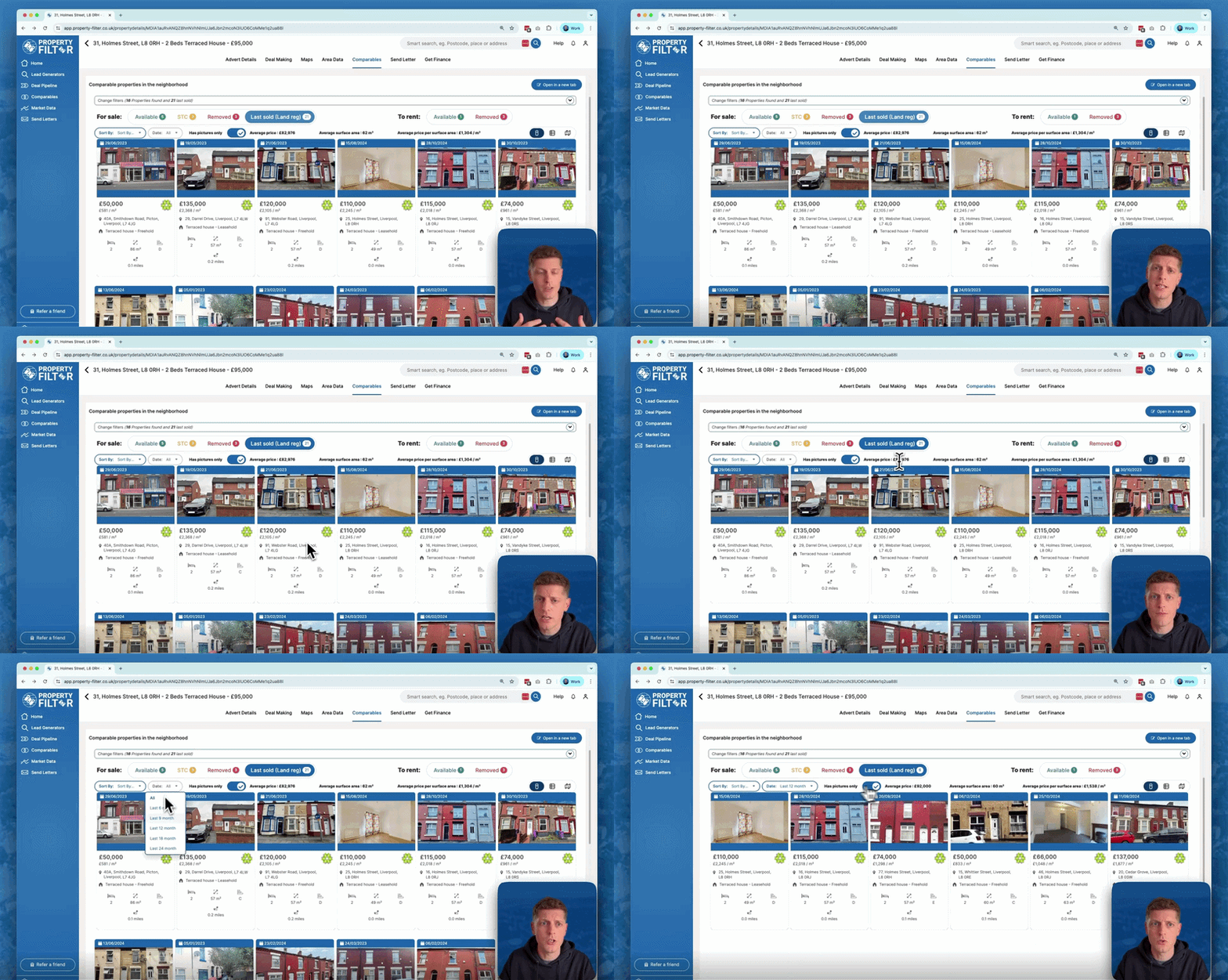
Jas describes comparables as his most important feature, and it is easy to understand why. Estate agents routinely over-inflate asking prices. Without independent comparable data, an investor is essentially negotiating on the agent's terms - accepting their valuation as the starting point and working down from there. Property Filter's comparables allow Jas to check the real market value of any property before deciding how to engage with it. If the agent's price does not stack up against recent sales data, he can move on quickly. If it does, he knows what his offer range should be and has the data to justify it.
Nisha is equally data-driven, though her focus sits on the price history graph and the full suite of property-level information - EPC rating, price per square foot, last sold price - that loads in a single card without any need to open multiple tabs or manually cross-reference sources. "I'm a data-hungry person," she says. "Anything with graphs, charts, the history graph and the pricing graph really helped me." For a partnership where both investors bring different analytical instincts to the same deal, having all the relevant data in one place means faster decisions and fewer disagreements.
Together, these features were central to their most significant deal: a 3-bed conversion to a 7-bed HMO in Medway that they tracked for over a year before securing it at £250,000 - £100,000 below the original asking price. The price history graph showed them the vendor's motivation over time; the comparables told them what the property and the area were actually worth. A property two doors away subsequently sold for £425,000.
"Comparables is one of the top things I'm looking at. It makes it so easy - if an agent's just trying to sell it to me, I can do my research very quickly and move on."
Nisha and Jas's favourite Property Filter feature: comparables
Jas describes comparables as his most important feature, and it is easy to understand why. Estate agents routinely over-inflate asking prices. Without independent comparable data, an investor is essentially negotiating on the agent's terms - accepting their valuation as the starting point and working down from there. Property Filter's comparables allow Jas to check the real market value of any property before deciding how to engage with it. If the agent's price does not stack up against recent sales data, he can move on quickly. If it does, he knows what his offer range should be and has the data to justify it.
Nisha is equally data-driven, though her focus sits on the price history graph and the full suite of property-level information - EPC rating, price per square foot, last sold price - that loads in a single card without any need to open multiple tabs or manually cross-reference sources. "I'm a data-hungry person," she says. "Anything with graphs, charts, the history graph and the pricing graph really helped me." For a partnership where both investors bring different analytical instincts to the same deal, having all the relevant data in one place means faster decisions and fewer disagreements.
Together, these features were central to their most significant deal: a 3-bed conversion to a 7-bed HMO in Medway that they tracked for over a year before securing it at £250,000 - £100,000 below the original asking price. The price history graph showed them the vendor's motivation over time; the comparables told them what the property and the area were actually worth. A property two doors away subsequently sold for £425,000.
"Comparables is one of the top things I'm looking at. It makes it so easy - if an agent's just trying to sell it to me, I can do my research very quickly and move on."
75%
75%
75%
75%
Research time saved
12-15
12-15
12-15
12-15
Deals accepted in 2 years
7 at once
7 at once
7 at once
7 at once
vs 1 every 18 months
£250k
£250k
£250k
£250k
Secured vs £350k asking
2-3x
2-3x
2-3x
2-3x
Times per week on platform
The results: 12 to 15 deals accepted, 75% of research time saved, and a £100,000 discount on their best HMO
The headline number is the scale. Nisha and Jas went from one deal every 18 months to 12 to 15 deals accepted over two years, with 5, 6, and 7 properties running simultaneously at their busiest points. They currently have 3 active deals, which they describe as a quieter period. That shift did not happen because they suddenly had more time - it happened because Property Filter gave them a process that could handle multiple deals in parallel without collapsing under its own weight.
Their standout deal illustrates both the patience and the discipline that the pipeline enables. They viewed a 3-bed property in Medway that they wanted to convert to a 7-bed HMO. The vendor rejected their offers. Rather than moving on, they kept the deal in their follow-up queue and maintained regular contact with the agent. Over a year later, the vendor came back - he had experienced 3 sales fall through and was now motivated to sell. Because Nisha and Jas had stayed visible and consistent, they were still the active buyer. They ended up securing the property at £250,000 - less than what they had originally offered - against an asking price of £350,000. A comparable property two doors away sold for £425,000. "It was probably one of our best deals because we did the follow-up," Nisha says. If you want to see how the pipeline and comparables work in practice, watch the on-demand demo.
The time savings are just as significant as the deal results. Jas estimates Property Filter has saved them around 75% of their research time. More than the hours, though, it has saved them energy. Nisha explains: "When you're sort of scrolling on Rightmove and bouncing from website to website, that takes time but also energy, and that energy does drain you." That energy now goes into analysis, into agent calls, into the letter campaigns they are building out, and into Castlewood Homes' expanding portfolio. Their letter campaign test - targeting withdrawn and 90-day-plus properties - generated 3 to 4 phone calls from around 10 to 12 addresses, adding a direct-to-vendor pipeline on top of the agent-sourced deals already running through Property Filter.
"Originally it was on for £350,000, and we secured it for £250,000 in the end. A property two doors away sold for £425,000."
Watch Nisha and Jas's full Property Filter story
Hear Nisha and Jas describe in their own words how they scaled Castlewood Homes, why the shared pipeline ended the arguments, and how they tracked a motivated vendor for over a year to secure their best deal at £100,000 below asking price.
The results: 12 to 15 deals accepted, 75% of research time saved, and a £100,000 discount on their best HMO
The headline number is the scale. Nisha and Jas went from one deal every 18 months to 12 to 15 deals accepted over two years, with 5, 6, and 7 properties running simultaneously at their busiest points. They currently have 3 active deals, which they describe as a quieter period. That shift did not happen because they suddenly had more time - it happened because Property Filter gave them a process that could handle multiple deals in parallel without collapsing under its own weight.
Their standout deal illustrates both the patience and the discipline that the pipeline enables. They viewed a 3-bed property in Medway that they wanted to convert to a 7-bed HMO. The vendor rejected their offers. Rather than moving on, they kept the deal in their follow-up queue and maintained regular contact with the agent. Over a year later, the vendor came back - he had experienced 3 sales fall through and was now motivated to sell. Because Nisha and Jas had stayed visible and consistent, they were still the active buyer. They ended up securing the property at £250,000 - less than what they had originally offered - against an asking price of £350,000. A comparable property two doors away sold for £425,000. "It was probably one of our best deals because we did the follow-up," Nisha says. If you want to see how the pipeline and comparables work in practice, watch the on-demand demo.
The time savings are just as significant as the deal results. Jas estimates Property Filter has saved them around 75% of their research time. More than the hours, though, it has saved them energy. Nisha explains: "When you're sort of scrolling on Rightmove and bouncing from website to website, that takes time but also energy, and that energy does drain you." That energy now goes into analysis, into agent calls, into the letter campaigns they are building out, and into Castlewood Homes' expanding portfolio. Their letter campaign test - targeting withdrawn and 90-day-plus properties - generated 3 to 4 phone calls from around 10 to 12 addresses, adding a direct-to-vendor pipeline on top of the agent-sourced deals already running through Property Filter.
"Originally it was on for £350,000, and we secured it for £250,000 in the end. A property two doors away sold for £425,000."
Watch Nisha and Jas's full Property Filter story
Hear Nisha and Jas describe in their own words how they scaled Castlewood Homes, why the shared pipeline ended the arguments, and how they tracked a motivated vendor for over a year to secure their best deal at £100,000 below asking price.
Frequently asked questions
How did Nisha and Jas scale from one deal every 18 months to seven at once using Property Filter?
How does Property Filter help property partnerships avoid duplicating work?
How do Nisha and Jas use the comparables feature to negotiate better offers?
Does Property Filter's letter campaign feature work for standard buy-to-let investors?
Is Property Filter suitable for experienced property investors, or mainly for beginners?

Ready to find your next property deal?
Property Filter gives you the shared pipeline, comparables, price history graphs, and letter campaign tools that Nisha and Jas Jassal use to run Castlewood Homes: systematically, collaboratively, and with the data to make confident offers.
Join over 1,800 active members already using Property Filter to source deals across the UK.
Ready to find your next property deal?
Property Filter gives you the shared pipeline, comparables, price history graphs, and letter campaign tools that Nisha and Jas Jassal use to run Castlewood Homes: systematically, collaboratively, and with the data to make confident offers.
Join over 1,800 active members already using Property Filter to source deals across the UK.