MEMBER's SUCCESS STORY
How Steve Octon Used Property Filter's Price History to Find a Motivated Seller and Buy His First BTL 25% Below Market Value

Spalding, South Lincolnshire. Multiple reductions spotted. Pre-auction offer accepted. 25% below market value, £300 per month cash flow.
Steve Octon · Spalding, South Lincolnshire · Buy-to-Let Investor · Interviewed Feb 2026
AT A GLANCE
Member
Steve Octon
Location
Spalding, South Lincolnshire
Background
Kitchen and bathroom fitter; self-employed property flipper
Strategy
Transitioning from flips to buy-to-let cash flow
PF Feature Used
Price history graphs; lead generators; pipeline; motivated seller indicators
Result
2-bed flat sourced through Property Filter; bought 25% below market value; £300/month cash flow; less than £1,000 of work required
"Taking action leads to actually buying properties. That's what's changed for me since I've used Property Filter."
- Steve Octon
Results like these are happening every week. See how Property Filter works.

Steve Octon spent years fitting kitchens and bathrooms across South Lincolnshire before realising he could build something more permanent. He transitioned into property flips, doing most of the work himself. Then the market changed. Flips were taking longer to sell, values were no longer rising on their own, and a strategy that had once worked was starting to feel like treading water. He joined Property Filter looking for a better approach, and found something he did not know existed: a 10-minute daily workflow that led directly to his first buy-to-let, acquired at 25% below market value with £300 a month in cash flow.
Steve Octon's challenge before Property Filter
Before Property Filter, Steve's deal-finding process looked the same as almost every investor's at the start: Rightmove, sorted by newest, filtered for properties added in the last 5 days. The problem with that approach is how much it hides. Properties that return to the market without a price reduction do not resurface at the top of the list. Back-on-market opportunities, price-reduced properties that have been sitting for months, vendors who are quietly becoming more motivated -- none of that is visible in a search configured for what was added this week.
To find motivated sellers, Steve had been concentrating on two specific sectors: probate properties and auctions. He knew those vendors were more likely to need to move. The problem was the ceiling. He was limiting his search to a narrow slice of the market by definition. Beyond probate and auction, motivated sellers were invisible to him -- not because they did not exist, but because Rightmove had no way of showing him who they were.
He did not know there was a better way. That is not an oversight; it is simply how most investors start. Rightmove is where everyone begins, and without a specific reason to look elsewhere, there is no obvious prompt to do so. When he eventually found Property Filter, his first reaction was scepticism: was this not just buy-to-let data presented in a different interface? It took using it properly to understand what it actually showed him.
"I didn't know there was a better way out there. I just was doing it because that was the only way I knew of."
How Steve Octon uses Property Filter to find deals in 10 minutes a day
Steve's initial hesitation about Property Filter was that it was "just what I can see on Rightmove anyway, presented in a different way." That impression lasted until he actually used the lead generators. Once he did, the difference became clear immediately. Property Filter was not showing him the same properties as Rightmove. It was showing him the properties that Rightmove's default view was hiding: everything that had been reduced, come back to market, or met specific motivated seller criteria that he had never been able to filter for before.
His daily workflow now takes 10 minutes. The lead generators surface 5 or 6 properties each morning that are worth a proper look. At roughly a minute each, the review takes 5 minutes. He then works through his pipeline -- checking on outstanding viewings, following up on offers, deciding next steps -- for another 5 minutes. The whole session is done before anything else in his day has started. On days when he is making an offer, he will spend a bit longer: 20 minutes or so to personalise the offer letter and include comparable data to justify the price he is proposing.
The second habit that makes this sustainable is zeroing down the lead generators every day. Nothing is left sitting in a list waiting to be looked at again. If a property is not worth an action, it is removed. If it is, it goes into the pipeline. That discipline -- combined with the pipeline's built-in workflow of assess, view, offer -- is what turned property research from an open-ended scrolling session into something resembling a system. The pipeline and lead generators gave him a structure that Rightmove never could.
"I can now spend 10 minutes a day just going through the lead generators and the pipeline. It's systemised things in a way that I wasn't doing before."
Steve Octon's challenge before Property Filter
Before Property Filter, Steve's deal-finding process looked the same as almost every investor's at the start: Rightmove, sorted by newest, filtered for properties added in the last 5 days. The problem with that approach is how much it hides. Properties that return to the market without a price reduction do not resurface at the top of the list. Back-on-market opportunities, price-reduced properties that have been sitting for months, vendors who are quietly becoming more motivated -- none of that is visible in a search configured for what was added this week.
To find motivated sellers, Steve had been concentrating on two specific sectors: probate properties and auctions. He knew those vendors were more likely to need to move. The problem was the ceiling. He was limiting his search to a narrow slice of the market by definition. Beyond probate and auction, motivated sellers were invisible to him -- not because they did not exist, but because Rightmove had no way of showing him who they were.
He did not know there was a better way. That is not an oversight; it is simply how most investors start. Rightmove is where everyone begins, and without a specific reason to look elsewhere, there is no obvious prompt to do so. When he eventually found Property Filter, his first reaction was scepticism: was this not just buy-to-let data presented in a different interface? It took using it properly to understand what it actually showed him.
"I didn't know there was a better way out there. I just was doing it because that was the only way I knew of."
How Steve Octon uses Property Filter to find deals in 10 minutes a day
Steve's initial hesitation about Property Filter was that it was "just what I can see on Rightmove anyway, presented in a different way." That impression lasted until he actually used the lead generators. Once he did, the difference became clear immediately. Property Filter was not showing him the same properties as Rightmove. It was showing him the properties that Rightmove's default view was hiding: everything that had been reduced, come back to market, or met specific motivated seller criteria that he had never been able to filter for before.
His daily workflow now takes 10 minutes. The lead generators surface 5 or 6 properties each morning that are worth a proper look. At roughly a minute each, the review takes 5 minutes. He then works through his pipeline -- checking on outstanding viewings, following up on offers, deciding next steps -- for another 5 minutes. The whole session is done before anything else in his day has started. On days when he is making an offer, he will spend a bit longer: 20 minutes or so to personalise the offer letter and include comparable data to justify the price he is proposing.
The second habit that makes this sustainable is zeroing down the lead generators every day. Nothing is left sitting in a list waiting to be looked at again. If a property is not worth an action, it is removed. If it is, it goes into the pipeline. That discipline -- combined with the pipeline's built-in workflow of assess, view, offer -- is what turned property research from an open-ended scrolling session into something resembling a system. The pipeline and lead generators gave him a structure that Rightmove never could.
"I can now spend 10 minutes a day just going through the lead generators and the pipeline. It's systemised things in a way that I wasn't doing before."
Feature Spotlight
Steve Octon's most important Property Filter feature: the price history graph
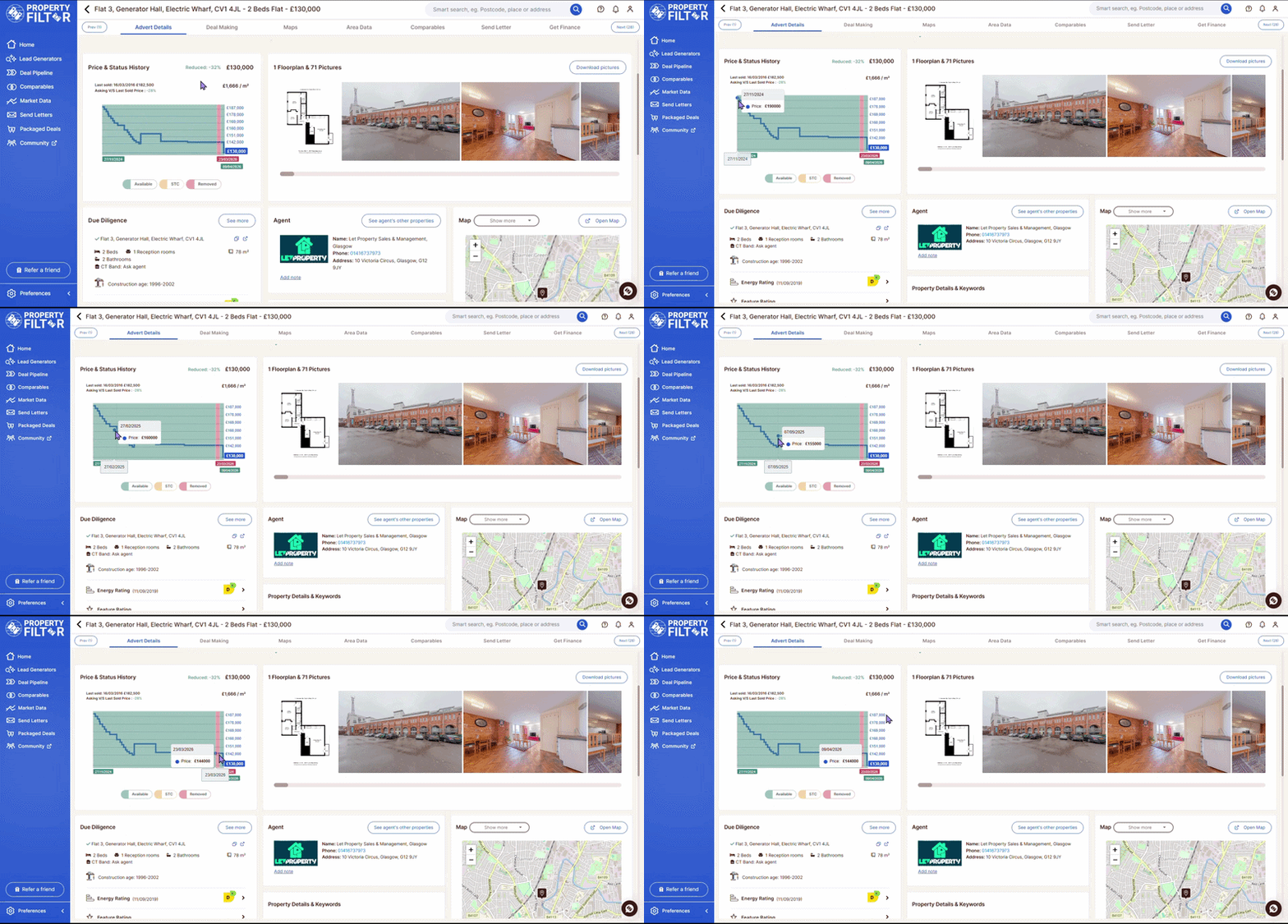
The price history graph was the feature that identified Steve's first buy-to-let. A 2-bed flat in South Lincolnshire had been listed with an estate agent towards the end of November. Within two weeks, it had been reduced. Shortly after, it was transferred to an auction company. At auction, it was reduced again. Multiple reductions across two different sales channels, in December -- one of the worst times of year to be selling property.
Property Filter showed all of this in a single graph. Without it, Steve might have seen the property at auction with no context for what had happened before. With it, he could see immediately that the vendor -- a retiring landlord -- had been trying to sell for weeks, had accepted less than the original asking price through two separate channels, and was in a December market with very little competing interest. The motivation was obvious. The opportunity was clear.
He made a pre-auction offer with a 48-hour validity. He told the agent he was actively looking at multiple properties and could only hold the offer open for that window. They negotiated briefly. He got the price he wanted, bought the flat at 25% below market value, and found a property that needed less than £1,000 of work before it was ready to let.
"The price history graph is amazing, because it really does show you when someone is really motivated, because they start to drop, and you can see those multiple reductions."
Steve Octon's most important Property Filter feature: the price history graph
The price history graph was the feature that identified Steve's first buy-to-let. A 2-bed flat in South Lincolnshire had been listed with an estate agent towards the end of November. Within two weeks, it had been reduced. Shortly after, it was transferred to an auction company. At auction, it was reduced again. Multiple reductions across two different sales channels, in December -- one of the worst times of year to be selling property.
Property Filter showed all of this in a single graph. Without it, Steve might have seen the property at auction with no context for what had happened before. With it, he could see immediately that the vendor -- a retiring landlord -- had been trying to sell for weeks, had accepted less than the original asking price through two separate channels, and was in a December market with very little competing interest. The motivation was obvious. The opportunity was clear.
He made a pre-auction offer with a 48-hour validity. He told the agent he was actively looking at multiple properties and could only hold the offer open for that window. They negotiated briefly. He got the price he wanted, bought the flat at 25% below market value, and found a property that needed less than £1,000 of work before it was ready to let.
"The price history graph is amazing, because it really does show you when someone is really motivated, because they start to drop, and you can see those multiple reductions."
10 mins
10 mins
10 mins
10 mins
Daily time on platform
25%
25%
25%
25%
Below market value
£300/mo
£300/mo
£300/mo
£300/mo
Cash flow after mortgage
<£1k
<£1k
<£1k
<£1k
Work needed before letting
5-6
5-6
5-6
5-6
More properties offered on since
The result: first BTL bought at 25% below market value, £300 per month cash flow, and a pipeline of offers
The flat was essentially ready to let from the day Steve completed. Less than £1,000 of minor work was needed. Cash flow after mortgage costs came in at £300 per month. His plan is to refinance after 6 months, pull out the equity he went in with at 25% below market value, and deploy that capital on the next property. That model -- buy below market value, hold briefly, refinance, repeat -- is the foundation of the cash flow portfolio he is building in South Lincolnshire.
Since buying the flat, Steve has offered on another 5 or 6 properties. He goes on 3 to 4 viewings each week and offers on most of them. The lead generators surface the candidates each morning. The price history tells him which vendors are motivated to sell. The pipeline keeps him moving through each one systematically rather than circling back to the same properties without taking action. "I've got probably three more properties I might offer on tonight," he said at the time of the interview.
The mindset shift he describes is the biggest change. Before Property Filter, he would see a property on Rightmove, think it might be worth looking at, and then scroll past it again the next day without doing anything about it. Now, every property gets a decision: add to pipeline and take action, or remove. There is no passive browsing. "Taking action leads to actually buying properties," he says. "That's what's changed for me." If you want to see how the lead generators and pipeline work in practice, watch the on-demand demo.
His top tip for other members: pick up the phone. The data tells you which properties to call about. The conversation tells you what the data cannot -- why the vendor is selling, what their timeline is, whether there is flexibility on price. "Just pick up the phone and speak to the agents," he says. "It's amazing what they tell you." Put the price history and the conversation together and you have everything you need to make a confident offer.
Watch Steve Octon's full Property Filter story
Hear Steve describe his deal in his own words, including how the price history graph identified the retiring landlord, how he structured his pre-auction offer, and what the switch from passive scrolling to systematic action-taking has meant for his property business.
The result: first BTL bought at 25% below market value, £300 per month cash flow, and a pipeline of offers
The flat was essentially ready to let from the day Steve completed. Less than £1,000 of minor work was needed. Cash flow after mortgage costs came in at £300 per month. His plan is to refinance after 6 months, pull out the equity he went in with at 25% below market value, and deploy that capital on the next property. That model -- buy below market value, hold briefly, refinance, repeat -- is the foundation of the cash flow portfolio he is building in South Lincolnshire.
Since buying the flat, Steve has offered on another 5 or 6 properties. He goes on 3 to 4 viewings each week and offers on most of them. The lead generators surface the candidates each morning. The price history tells him which vendors are motivated to sell. The pipeline keeps him moving through each one systematically rather than circling back to the same properties without taking action. "I've got probably three more properties I might offer on tonight," he said at the time of the interview.
The mindset shift he describes is the biggest change. Before Property Filter, he would see a property on Rightmove, think it might be worth looking at, and then scroll past it again the next day without doing anything about it. Now, every property gets a decision: add to pipeline and take action, or remove. There is no passive browsing. "Taking action leads to actually buying properties," he says. "That's what's changed for me." If you want to see how the lead generators and pipeline work in practice, watch the on-demand demo.
His top tip for other members: pick up the phone. The data tells you which properties to call about. The conversation tells you what the data cannot -- why the vendor is selling, what their timeline is, whether there is flexibility on price. "Just pick up the phone and speak to the agents," he says. "It's amazing what they tell you." Put the price history and the conversation together and you have everything you need to make a confident offer.
Watch Steve Octon's full Property Filter story
Hear Steve describe his deal in his own words, including how the price history graph identified the retiring landlord, how he structured his pre-auction offer, and what the switch from passive scrolling to systematic action-taking has meant for his property business.
Frequently asked questions
What is Property Filter and how does it help with buy-to-let investing?
What is the price history feature on Property Filter and how does it reveal motivated sellers?
How can a new investor use Property Filter to take consistent action on property deals?

Ready to find your next property deal?
Property Filter gives you the price history graphs, lead generators, and pipeline tools to work the way Steve Octon works: systematically, efficiently, and with the data you need to make confident offers.
Join over 1,800 active members already using Property Filter to source deals across the UK.
Ready to find your next property deal?
Property Filter gives you the price history graphs, lead generators, and pipeline tools to work the way Steve Octon works: systematically, efficiently, and with the data you need to make confident offers.
Join over 1,800 active members already using Property Filter to source deals across the UK.