Lease Extension Calculator UK
Estimate the statutory premium for your leasehold flat or house in England and Wales. Enter three numbers and get an instant breakdown of ground-rent loss, reversionary interest, and marriage value, all in plain English.
Enter whole years for the lease, your annual ground rent in £, and the estimated value of the property after a 90-year extension at peppercorn rent.
What is the short lease investment strategy?
What You'll Calculate
What This Calculator Works Out
Estimated Premium Range
The total premium you are likely to pay, shown as a low-to-high band (±3% around the calculated average).
Ground-Rent Loss
The capitalised value of the ground rent income the freeholder loses when it becomes peppercorn. Calculated using a 6% years-purchase factor.
Reversionary Interest
The present value of the freeholder waiting longer to get the property back. Calculated using a 5% deferment rate over the current term and the extended term.
Marriage Value
Only applies if your lease has fewer than 80 years left. When extending a short lease increases the property's combined value, you pay the freeholder 50% of that uplift.
What's Included
What This Calculator Covers
Covers flats and houses in England and Wales under the Leasehold Reform, Housing and Urban Development Act 1993 and the Leasehold Reform Act 1967
Breaks down all three components of the statutory premium so you can see exactly where the number comes from
Automatically flags and applies marriage value for leases under 80 years
How It WorkS
How to Use the Calculator
Enter years left on lease
Input the whole number of years remaining on your lease. Months are not needed. Whole years are fine for this estimate.
Enter annual ground rent
Enter the current ground rent in pounds per year (£ p.a.). Check your lease document if you are unsure. Use zero if your ground rent is already peppercorn.
Enter property value once extended
This is the estimated market value of the property after a 90-year extension at peppercorn ground rent. Use recent comparable sales of long-lease flats in the same area, or ask an estate agent for guidance.
Click Calculate
Your estimated premium range appears instantly, with a full line-by-line breakdown showing how each component was calculated.
Why the 80-Year Threshold Matters?
The 80-Year Rule
Why extending sooner always costs less
A lease below 80 years triggers marriage value, and the cost difference is dramatic.
Above 80 years: Premium = ground-rent loss + reversionary interest only. Typically £5,000–£10,000 for an average property.
Below 80 years: Marriage value is added. For every year under 80, the premium climbs sharply. A lease at 79 years can cost nearly double a lease at 81 years.
The takeaway: If your lease is approaching 80 years, extending now is almost always cheaper than waiting. Every year of delay adds cost, sometimes thousands of pounds per year.
Investor note: Properties with leases of 75–79 years are often priced at steep discounts because buyers expect marriage value. If you can accurately estimate the extension cost, these can be some of the most mispriced assets in the UK market. Use Property Filter to find motivated sellers with short leases in your target area.
The Maths Behind the Calculator
The statutory formula, presented without the jargon.
The premium follows a three-part calculation set out in Schedule 13 of the Leasehold Reform, Housing and Urban Development Act 1993.
Symbols used:
G = Annual ground rent (£)
T = Years left on the current lease
V = Property value once extended at peppercorn rent (£)
v = Current property value with the short lease (£), expressed as a relativity to V based on tribunal evidence
ε = Yield/discount rate (6% for ground rent, 5% for reversion)
The freeholder loses the ground rent income for the remaining lease term. This income stream is capitalised using a 6% yield rate.
Ground-rent loss:
The lower the interest rate used, the higher the capitalised value. RICS surveyors may argue different rates in negotiations.
The freeholder loses the right to reclaim the full property value at lease end. Without extension, they wait T years. With extension, they wait T + 90 years. The difference between those two present values is the reversionary interest.
A 5% deferment rate is the standard used by this calculator. Higher rates produce lower reversion values, which is another point surveyors negotiate.
Extending a short lease typically makes the property worth more than the sum of its parts today. That uplift is called marriage value, and under current legislation the leaseholder pays 50% of it.
In practice, v is estimated using a relativity table: the ratio of short-lease to long-lease value for a given number of years remaining, based on market and tribunal evidence.
If the lease is 80 years or more, marriage value does not apply and this component = £0.
Average premium = Ground-rent loss + Reversionary interest + Marriage value
Low estimate = Average × 0.97
High estimate = Average × 1.03
The ±3% band reflects the fact that real-world negotiations, comparables, and surveyor assumptions vary. The band is a guide, not a guarantee.
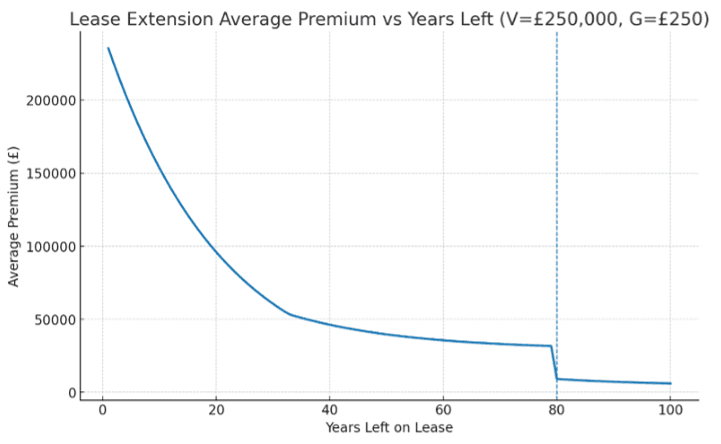
Extension premiums rise steeply as leases fall below 80 years and marriage value kicks in.
How Long Is the Lease After Extension?
What you actually get: flats, houses, and informal routes
Example: 67 years remaining → new lease = 157 years at £0 ground rent.
Example: If you have 45 years left today: your new lease end becomes 45 + 50 = 95 years from today. During the extra 50 years, you pay modern ground rent instead of your old ground-rent terms.
Why is the rule different for houses? Houses are covered by a different piece of legislation. The policy intent is that you can either extend by 50 years (with modern ground rent) or buy the freehold (enfranchise). Many owners compare both routes.
Two-year ownership rule abolished (31 January 2025): You no longer need to own a property for two years before serving a statutory extension notice. You can purchase and extend immediately.
Leasehold and Freehold Reform Act 2024: Parliament has legislated for extensions up to 990 years and the abolition of marriage value, but several provisions require further secondary legislation before they apply. Until commenced, the rules above (+90 for flats, +50 for houses) remain the operative ones.
Understanding Your Results
Estimated Premium Range
The average premium ±3%, giving you a realistic low-to-high band for planning and negotiation
Ground-Rent Loss
The capitalised value of the ground rent income the freeholder gives up. Based on your inputs and a 6% years-purchase factor.
Reversionary Interest
The difference between the freeholder's discounted reversion at the current term end and the extended term end, using a 5% deferment rate.
Marriage Value
Only shown if your lease is under 80 years. Represents 50% of the increase in combined interests created by the extension.
These are standard, widely used parameters for educational calculators. Professionals may apply different rates, relativities, and comparable evidence depending on market conditions and tribunal precedents.
⚠️ Disclaimer: This tool is for educational purposes only and does not constitute financial or legal advice. Always seek professional guidance from a RICS surveyor and specialist leasehold solicitor before making investment decisions.
This calculator gives you a starting point. A surveyor gives you a defensible number
Use this estimate to sense-check a deal or understand the mechanics. Always instruct a specialist RICS surveyor and leasehold solicitor before:
Serving a formal Section 42 Notice
Dealing with escalating or doubling ground rent
Negotiating with a freeholder
Buying a property specifically to extend the lease
A surveyor brings comparable market evidence. A solicitor ensures the process and terms protect your position. Using non-specialist professionals is one of the most common (and expensive) mistakes in lease extension deals.
Common Questions
Frequently Asked Questions
Is this calculator's estimate exact?
Why does the number jump at 80 years?
What should I use for "value once extended"?
How long is the lease after extension?
Can I just pay the calculator's figure?
When should I speak to a professional?
More Free Tools
More Free Property Calculators
Every calculator your deals need. Free, no signup required.
Ready to Go Further?
Find Short Lease Deals
Before Anyone Else
Property Filter helps you identify motivated sellers with sub-80-year leases, filter by lease length, and assess deals in seconds.
Join 1,800+ UK investors using Property Filter to find, filter, and assess deals faster. Access the full suite of calculators, a custom deal map, and.motivated-seller data, all in one platform.